


Cutting-edge Data Centers
Where all our services begin
Utilize the latest technologies, architectural designs, and operational efficiencies to provide superior performance, security, and reliability.
-

 Strategic locations
-

 Enhanced security
-

 Advanced infrastructure
-

 High connectivity and redundancy
-

 Energy efficiency
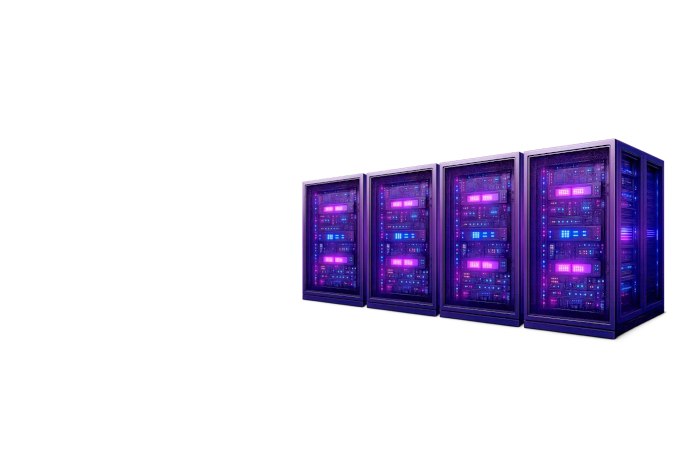 10 Countries

 4 Continents

 23 Data centers

 Tier III DCs
Advanced technological features
Top-Tier infrastructure
Essential for delivering exceptional performance, reliability, and security. It encompasses high-performance servers, advanced storage solutions, and robust networking equipment that ensure optimal data throughput. Combined with redundant power supplies, this infrastructure supports scalability and enhances operational efficiency, making it ideal for modern enterprises.
Commitment to energy efficiency
Crucial for reducing operational costs and minimizing environmental impact. Utilizing advanced cooling technologies, efficient power management, and renewable energy sources, data centers are significantly lowering energy consumption. This commitment to sustainability not only enhances performance but also aligns with corporate responsibility goals, making it vital for modern businesses.
Tier-level network redundancy
Vital for ensuring uninterrupted operations and minimizing downtime. By employing multiple internet connections and diverse network paths, data centers are maintaining seamless connectivity even during outages or failures. This redundancy not only enhances reliability but also supports high availability for critical applications, providing businesses with the resilience they need in today’s digital landscape.
Advanced high-efficiency cooling
Along with indirect adiabatic cooling, techniques like immersion and liquid cooling are also used, providing superior thermal management, improving performance and energy efficiency. Immersion cooling submerges components in a thermally conductive liquid, while liquid cooling utilizes coolant pipes to draw heat away, ensuring optimal temperatures and extending hardware lifespan in dense environments.
Security measures

Physical security
- Access control: Biometric scanners, keycard access, and security guards limit entry to authorized personnel only.
- Surveillance: High-definition cameras monitor the facility 24/7, providing a record of all activities.
- Environmental controls: Fire suppression systems, flood protection, and climate control maintain optimal conditions.
Compliance and audits
- Regulatory compliance: Adherence to standards such as GDPR, HIPAA, and PCI-DSS ensures legal and industry compliance.
- Third-party audits: Regular assessments by external specialists validate security practices and identify improvement areas.
Operational security
- Employee training: Regular security training for staff ensures they understand protocols and potential threats like social engineering.
Extensive operating system оptions
Ubuntu

Debian

CentOS

Fedora

AlmaLinux

CloudLinux

Windows

Proxmox VE

pfSense

openSUSE

MacOS

VMware

Microsoft

ISO

Windows2

Proxmox VE
openSUSE
pfSense
Debian
Ubuntu

FAQ
-
Where are INTROSERV data centers located, and how do I choose a location for a dedicated server?
INTROSERV servers are hosted in 23 data centers (DCs) across 10 countries on 4 continents. All data centers are Tier III facilities. The current list of locations and available configurations is shown when you order a dedicated server.
Choose a location as close as possible to your target audience: a shorter distance means lower latency and faster server response. Also consider the personal data storage requirements in your region. Before ordering, you can compare latency and routes to several locations free of charge and without registration using Looking Glass (ping, traceroute, MTR):
- Netherlands: servers · Looking Glass
- Germany: servers · Looking Glass
- France: servers · Looking Glass
- Poland: servers · Looking Glass
- United Kingdom: servers · Looking Glass
- USA: servers · Looking Glass
- Canada: servers · Looking Glass
- Australia (Sydney): servers · Looking Glass
- Singapore: servers · Looking Glass
- India (Mumbai): servers · Looking Glass
Our team will help you choose the best location for your project.
-
What is Tier III, and what availability do Tier III data centers provide?
Tier III is a data center reliability level under the Uptime Institute classification, in which maintenance is carried out without shutting down equipment. The infrastructure has fully redundant power and cooling systems, so servers keep running without interruption during planned work. The servers we offer are hosted in Tier III data centers.
For this tier, the Uptime Institute defines an availability of 99.982%, which corresponds to no more than 1.6 hours of downtime per year. This is a characteristic of the infrastructure tier; the contractual availability guarantees and the recalculation terms for downtime are set out in the contract-offer. See current plans and prices.
-
How is uninterrupted power supply ensured in the data centers?
Uninterrupted power is provided by independent power feeds, UPS systems and diesel generators. Each facility receives electricity from independent feeds. If the primary feed fails, UPS units take over the load instantly, and during prolonged outages diesel generators start automatically and power the data center until the utility supply is restored. Duplicated power distribution paths allow engineers to service the electrical system without shutting down server equipment.
-
How are network and internet connectivity made redundant?
The data centers connect to the internet through several independent backbone providers over redundant fiber-optic routes. If one route fails, traffic is rerouted to another instantly. This ensures continuous network availability of your server.
-
How are servers cooled in the data center?
The data centers use high-efficiency cooling systems: adiabatic, liquid or immersion cooling (depending on the site). A stable temperature protects components from wear and sustains maximum performance under critical loads, including for resource-intensive solutions such as GPU servers.
-
How does a data center protect servers from fire and flooding?
Protection is provided by early smoke detection, automatic fire suppression, leak protection and precision climate control. Together, these systems maintain safe operating conditions for the equipment around the clock.
-
What is the difference between N+1 and 2N redundancy?
N+1 means one additional spare component for each critical element (for example, a power supply unit or a cooling system) that takes over if the primary one fails. 2N provides two parallel circuits with 100% duplication of the entire critical system. Tier III facilities typically use at least an N+1 configuration.
-
How is the physical security of data centers ensured?
Access to the site is controlled by biometric scanners, access cards and security personnel, and only authorized staff may enter. High-resolution cameras provide 24/7 video surveillance of the facility. Protection at the server level is provided by the server security configuration service.
-
What standards do the data centers comply with?
The data centers meet the requirements of standards such as GDPR, HIPAA and PCI DSS. Regular third-party audits confirm the effectiveness of security measures and help identify areas for improvement. How we process personal data is described in our privacy policy.
-
Can a dedicated server be moved to another data center?
A physical dedicated server stays in the data center where it is installed. To change location, order a new server in the required region and perform a data migration. We recommend creating a backup before migrating. If you need advice or help with the transfer, contact support.


