
Deploy GitLab EE in one click
The complete DevSecOps platform on your own server
GitLab is the all-in-one platform for the entire software lifecycle – Git repositories, code review, CI/CD, and registries in a single application.
-

 Git repositories and merge requests
 -

 Built-in CI/CD pipelines
 -

 Container and package registries
 -

 Issue tracking and boards
 -

 Wikis and GitLab Pages
 -

 Code review with approvals

 Installs with
your VPS

 Full root
access

 Data stays on
your server

 Free tier needs
no license
Key features
Review code in threaded discussions, require approvals before merging, and keep every change traceable to an issue.
Define builds, tests, and deployments in a single .gitlab-ci.yml – pipelines run on your own runners with no compute-minute limits.
Push and pull Docker images straight from CI jobs – private, integrated, and scoped to your projects.
Publish npm, Maven, PyPI, NuGet, and other packages to a private registry that lives next to the code.
Connect clusters through the GitLab agent and drive deployments from the same pipelines that build your images.
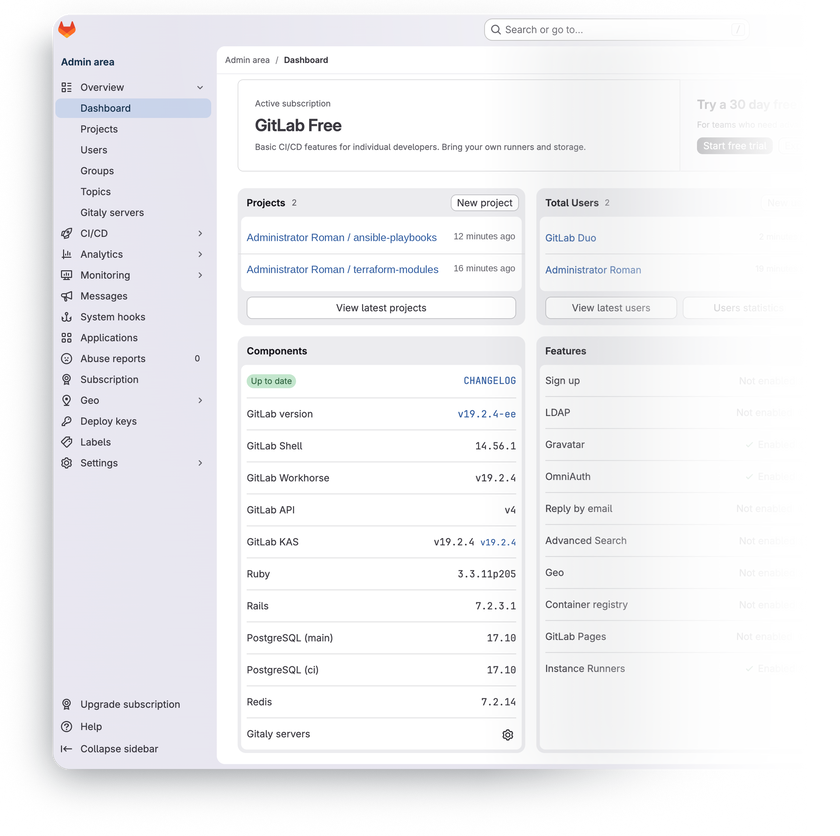
The EE package unlocks Premium or Ultimate features with an activation code from GitLab – no reinstallation or migration.
System requirements
View All VPS Options
Get started in 4 easy steps
-
1
Select a VPS plan
Choose the virtual server resources and performance tiers that fit your project requirements.
-
2
Pick your application
Browse our marketplace during VPS setup and select the self-hosted software you want to deploy.
-
3
Complete the payment
Pay the standard virtual server invoice – the 1-click deployment tool itself is fully complimentary.
-
4
Complete and access
Your server provisions and automatically installs the software. Once the setup process finishes, your new environment is fully ready for you to connect and use.
Deployment details


Application
GitLab Enterprise Edition – latest stable release
- Official gitlab-ee package repository, native installation
- Runs on the Free tier out of the box – paid features with a GitLab subscription
Operating system
Ubuntu 24.04 LTS – clean minimal install
- Native packages, no containers
- Full root access over SSH


Web access and SSL
Nginx bundled inside the GitLab package
- All web settings live in one file, /etc/gitlab/gitlab.rb
- setup-ssl script issues a free certificate through GitLab's Let's Encrypt integration


Components and database
Everything GitLab needs ships in one package
- PostgreSQL bundled and tuned by the package
- Redis, Gitaly, Puma, and Sidekiq preconfigured and managed by gitlab-ctl


Software licensing
GitLab EE License – source-available, Free tier
- Without an activation code, all Free tier features work with no limits
- Premium and Ultimate features require a GitLab subscription
- Full EE License text
Why deploy on INTROSERV
-


NVMe storage
Every VPS runs on NVMe drives – fast I/O for databases, metrics, and busy workloads.
-


Locations in Europe and the US
Deploy close to your infrastructure and users – lower latency, regional compliance.
-


Unmetered traffic
No bandwidth caps and no overage bills – your monthly price stays predictable.
-


IPv4 and IPv6 included
A dedicated IPv4 address plus native IPv6 with every server.
-


24/7 human support
Engineers on duty around the clock – real answers, not ticket bots.
-


Scale anytime
Upgrade CPU, RAM, or storage as your workload grows – without migrating.
Terms and support boundaries
Infrastructure and support limits
Our company provides the Virtual Private Server infrastructure and the automation script for initial deployment. While we guarantee the availability and performance of your hardware and network, our technical support exclusively covers infrastructure-related issues – such as server connectivity, hardware stability, and billing. Assistance with application-specific configuration, software bugs, or user management is the responsibility of the server administrator or software maintainers.
Software licensing and compliance
All marketplace tools deploy standard versions of third-party software products and are provided "as-is" with no modifications to their original code. While the core of many available applications is open-source, using proprietary features or advanced enterprise tiers in production environments may be subject to the vendor's specific licensing terms. Users must manage and acquire any required commercial subscriptions directly from the software developers.
FAQ
-
Do I need to pay GitLab to use this?
No. A fresh GitLab EE instance without an activation code runs all Free tier features indefinitely – repositories, CI/CD, registries, issues, and wikis. Premium and Ultimate features unlock only after you purchase a subscription directly from GitLab and enter the activation code in the admin area.
-
Why deploy EE instead of the Community Edition?
GitLab itself recommends the EE package even for free use: it runs exactly the Free feature set without a license, and if you ever need Premium or Ultimate, you activate them with a code – no reinstallation, package switch, or data migration. With CE you would have to convert the installation first.
-
How do I log in after deployment?
Once your server is provisioned, get your server IP and root password from your INTROSERV panel, connect to the server via SSH, and run the gitlab-setup command. Wait for the configuration to finish, and your web interface URL, username, and password will be displayed directly in the terminal console. Once complete, open the URL in your browser to sign in over HTTPS we strongly recommend changing your password and creating your own account right after your first login.
-
How do I get a valid SSL certificate?
Point a domain at your server, connect over SSH, and run the setup-ssl script – it configures GitLab's native Let's Encrypt integration for you, no external tooling and no manual edits to gitlab.rb. The certificate renews automatically; ports 80 and 443 must stay reachable for validation.
-
Can I run CI/CD pipelines on this server?
Pipelines are unlimited on self-managed GitLab – you bring your own runners, and there are no compute-minute quotas. Install gitlab-runner on a separate machine or a second small VPS: GitLab advises against running build jobs on the GitLab host itself, since heavy jobs compete with the application for CPU and memory.
-
Can I migrate my existing GitLab installation?
Yes. Create a backup with gitlab-backup on the old server, transfer the archive together with /etc/gitlab/gitlab-secrets.json and gitlab.rb, and restore it on the new one. The restore target must run the same GitLab version and edition as the source, so match versions before you move.
-
How are updates handled?
The server tracks the official gitlab-ee repository, so updates arrive through apt. You have full root access and decide when to apply them – nothing updates behind your back. For jumps across several versions, follow GitLab's documented upgrade path rather than skipping straight to the latest release.
-
What if I outgrow my configuration?
Upgrade CPU, RAM, or storage of your VPS as your team grows – no reinstallation needed. A single node at GitLab's baseline spec covers up to 1,000 users; beyond that, GitLab publishes multi-node reference architectures, and our engineers can help you plan the move to dedicated hardware.