If a business operates in more than one country and its management systems and email require employees to be able to access their workspaces from anywhere, the question of ‘where and how to host everything’ shifts from a technical issue to a strategic one. This case study demonstrates how a turnkey remote infrastructure was set up for a network of car repair workshops: A single dedicated server in Frankfurt, a fully open-source software stack and secure access for international staff – without the customer having to bear the cost of Windows Server, MS SQL Server or RDS CAL licences.
Background
The client is an entrepreneur who has relocated to Poland and is expanding their business there: today, the car repair workshop chain operates in several countries, including both the new Polish market and the main market where the business began. For operational and management accounting (vehicle intake, work orders, spare parts warehouse, inter-company settlements), the company uses the BAS Auto Repair accounting system, which runs on the BAF technology platform. The client already held licences for the platform and configuration and was managing the application layer independently with the support of an in-house Chief IT Specialist.
INTROSERV was responsible for the rest of the infrastructure: server hardware, virtualisation, the database management system (DBMS), remote desktop access for international staff, backups, email and the network environment. The old system was extremely simple, and the in-house specialists were sufficient. However, the new infrastructure required a completely different level of expertise.

The Task
The main complexity lay not in the accounting system itself—which the client had configured independently—but in establishing a production-grade infrastructure based on open-source software that could be maintained smoothly without constant IT intervention.
Many integrators opt for the easiest route in such projects: a RDS terminal server running on Windows Server + MS SQL Server, with user CALs added. For a car repair chain with a small team, this stack is unnecessary and far too costly. The BAF platform officially supports PostgreSQL; this has paved the way for the complete elimination of Microsoft licences.
As part of the project, it was necessary to set up a hypervisor and a dedicated backup server, ensure PostgreSQL was properly isolated to guarantee the consistency of database backups, provide secure remote access, and migrate the client’s existing email infrastructure. Everything had to be transparent and manageable: the customer receives a ready-to-use platform and continues to manage the application layer independently.
Infrastructure Configuration

Primary node: Located in Frankfurt, featuring a 24-core AMD EPYC™ processor, 128 GB RAM and two storage arrays (2×500 GB SSDs for the operating system and 2×2 TB SSDs for data), both running on ZFS mirrors. The server runs Proxmox VE 9.2, the latest version of an open-source virtualisation platform based on Debian 13 with native ZFS support.
A second server, connected via the local network, runs Proxmox Backup Server: 8-core, 32 GB RAM, 2×500 GB SSDs for the operating system and 2×4 TB SSDs for backup storage. Moving the backup server to a dedicated machine was a deliberate decision: a failure on the main node must not jeopardise the integrity of the backups.
Logical Architecture
-
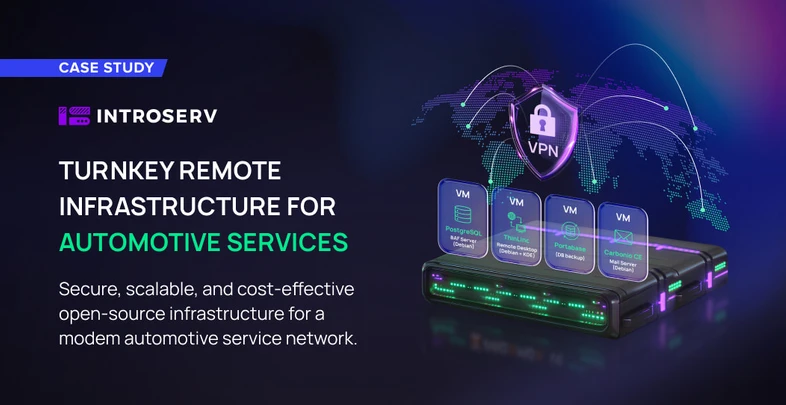
At the entry point – an OPNsense software router and firewall with VPN termination; all external access takes place exclusively via VPN.
-
The main Proxmox VE node hosts the virtual machines: VM #1 (Debian, BAF server + PostgreSQL) – core accounting system; VM #2 (Debian with KDE and ThinLinc web interface) – remote desktop server; VM #3 (Portabase) – database backup section; a separate VM – Carbonio CE mail server; VM #5 OPNsense – software router.
-
The PBS server backs up all virtual machines via the local network.
-
Staff working from different countries connect via VPN and work on the accounting system via the ThinLinc desktop.
Solution
INTROSERV engineers designed the infrastructure according to the principle of ‘a single isolated VM for each service’, making maintenance, backup management and access control much simpler.
- Accounting Core on PostgreSQL. VM #1 (Debian) runs the BAF server and PostgreSQL instead of the traditional Windows Server + MS SQL package. The client has independently installed the BAS configuration on top of this core.
- Remote Access via ThinLinc. VM #2 runs Debian with the KDE desktop environment and the Cendio ThinLinc terminal server. Staff connect using a local client or directly via a web browser. ThinLinc is free for up to 10 concurrent users – an excellent alternative to RDS for small teams. User accounts were created in accordance with the specifications, and provision was made for the client to add licences should the team grow.
- Two-Stage Backups. PostgreSQL backup management is isolated on a dedicated virtual machine running Portabase; Portabase is an open-source tool for centralised database backup management, featuring scheduling, retention policies and an agent-based, inherently secure architecture. At the same time, all virtual machines are backed up to a dedicated Proxmox Backup Server using incremental and deduplicated backups, with client-side encryption.
- Perimeter Security on OPNsense. The OPNsense software router and firewall terminates all VPN connections: neither RDP nor web management interfaces are exposed to the public internet – all remote access passes through a secure tunnel.
- Email Migration to Carbonio CE. The most delicate challenge was migrating the mail server from the customer’s previous hosting provider to Carbonio Community Edition. Migrating mailboxes and message history with zero data loss is always a highly delicate process, and the experience of INTROSERV’s system administrators proved vital at this stage. All other implementation phases proceeded as routine.
The fully configured platform was handed over to the client; the client took charge of the accounting software’s configuration and ongoing management.
Turnkey Infrastructure as an Economic Strategy
Rather than a set of independent services, the client received a production-ready, integrated system comprising isolated virtual machines, two-stage backups and a closed VPN environment – all whilst paying zero Microsoft licence fees.
For comparison, a standard proprietary software stack (Windows Server Standard, MS SQL Server Standard, RDS CALs for approximately 10 users) would have required an upfront cost of approximately 6,000–11,000 dollars. Instead, the solution utilises PostgreSQL instead of MS SQL, ThinLinc instead of RDS, Proxmox VE and PBS instead of paid virtualisation and backup software, and OPNsense and Carbonio CE instead of commercial equivalents.
The direct software savings represent only a fraction of the value delivered. The project has delivered several key business benefits:
-
Single point of responsibility – hardware and system management services were provided by a single company. The client did not have to vet external managers or coordinate between the hosting provider and third-party engineers: INTROSERV engineers took end-to-end responsibility for infrastructure deployment and performance.
-
Rapid time-to-market – the entire infrastructure, from the hypervisor and DBMS to the mail server and VPN gateway, was commissioned and handed over to production within a week.
-
Ongoing support – ongoing maintenance is carried out by the same engineering team that designed and set up the environment, who know its architecture down to the finest detail.
-
Predictable budget – The only software components subject to a fee are the client’s existing BAF and BAS licences. The infrastructure stack incurs no recurring software licence fees, either during installation or for future updates.
Are you looking to set up an accounting or ERP system on a cost-predictable open-source stack? The INTROSERV team can carry out an infrastructure audit, select the most suitable hardware and deliver a turnkey solution, from the hypervisor right through to the backup strategy.