
Deploy Portabase in one click
Self-hosted database backups, ready in minutes
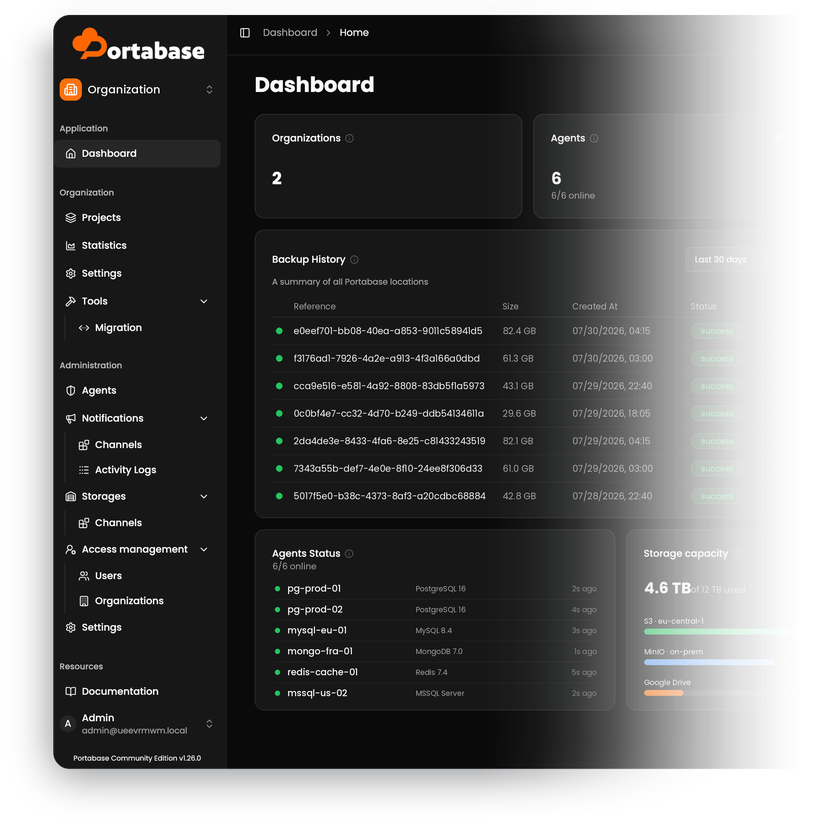
Portabase is an open-source control plane for database backup and restore – you define schedules, retention, and destinations in one dashboard, and lightweight agents run the dumps next to your databases.
-

 Nine database engines
 -

 Cron schedules and manual runs
 -

 AES-GCM encrypted backup files
 -

 S3, Google Drive, and local targets
 -

 Count, time, and GFS retention
 -

 Agents need no inbound ports

 Installs with
your VPS

 Preconfigured
container stack

 Live in
~2 minutes

 Full
Fullroot access
Key features
Agents poll the dashboard outbound and execute dumps next to the databases, so nothing on the protected network has to accept an inbound connection.
Files are protected with AES-GCM, and each storage channel reports its own send status – a success means the path, size, and checksum were verified.
Keep the last N backups, keep everything from the last N days, or run a Grandfather-Father-Son rotation across daily, weekly, monthly, and yearly points.
Multiple storage policies on one database send the same backup file simultaneously to local disk, S3-compatible buckets, Google Drive, and Google Cloud Storage.
Restore from a stored backup or from a file sitting in a storage channel, or upload an external dump through the dashboard – every supported engine except Redis and Valkey can be restored.
Per-database policies fire on backup or restore success and failure and on an unreachable database, routed to Slack, Discord, Telegram, ntfy, Gotify, email, or a webhook.
System requirements
View All VPS Options
Get started in 4 easy steps
-
1
Select a VPS plan
Choose the virtual server resources and performance tiers that fit your project requirements.
-
2
Pick your application
Browse our marketplace during VPS setup and select the self-hosted software you want to deploy.
-
3
Complete the payment
Pay the standard virtual server invoice – the 1-click deployment tool itself is fully complimentary.
-
4
Complete and access
Your server provisions and automatically installs the software. Once the setup process finishes, your new environment is fully ready for you to connect and use.
Deployment details


Application
Portabase – current stable release, the project publishes no LTS branch
- Official portabase/portabase image
- Database, and web interface running out of the box
Operating system
Ubuntu 24.04 LTS – clean minimal install
- Docker Engine and the Compose plugin preinstalled
- Full root access over SSH


Web access and SSL
Nginx serving the Portabase dashboard over HTTPS
- Self-signed certificate enabled by default
- Built-in
setup-sslscript issues a free Let's Encrypt certificate


Database
Everything the dashboard needs to accept its first agent
- PostgreSQL 17 container configured and connected automatically
- PROJECT_SECRET encrypts communication


Software licensing
Apache License 2.0 – open-source, no license fees
- No limits on agents, databases, or users
- Full Apache 2.0 license text
Why deploy on INTROSERV
-
NVMe storage
Every VPS runs on NVMe drives – fast I/O for databases, metrics, and busy workloads.
-


Locations in Europe and the US
Deploy close to your infrastructure and users – lower latency, regional compliance.
-


Unmetered traffic
No bandwidth caps and no overage bills – your monthly price stays predictable.
-


IPv4 and IPv6 included
A dedicated IPv4 address plus native IPv6 with every server.
-


24/7 human support
Engineers on duty around the clock – real answers, not ticket bots.
-


Scale anytime
Upgrade CPU, RAM, or storage as your workload grows – without migrating.
Terms and support boundaries
Infrastructure and support limits
Our company provides the Virtual Private Server infrastructure and the automation script for initial deployment. While we guarantee the availability and performance of your hardware and network, our technical support exclusively covers infrastructure-related issues – such as server connectivity, hardware stability, and billing. Assistance with application-specific configuration, software bugs, or user management is the responsibility of the server administrator or software maintainers.
Software licensing and compliance
All marketplace tools deploy standard versions of third-party software products and are provided "as-is" with no modifications to their original code. While the core of many available applications is open-source, using proprietary features or advanced enterprise tiers in production environments may be subject to the vendor's specific licensing terms. Users must manage and acquire any required commercial subscriptions directly from the software developers.
FAQ
-
Do I need a paid plan to run Portabase?
No. Portabase is released under the Apache License 2.0, with no cap on agents, databases, or users and no separate commercial tier to unlock. You only pay the standard virtual server invoice.
-
How do I log in after deployment?
Once the server is provisioned, you'll find the dashboard URL and a securely generated password in the Marketplace tab of your INTROSERV panel. Open it over HTTPS and sign in – we recommend setting your own password after the first login.
-
How do I get a valid SSL certificate?
The server ships with a self-signed certificate enabled by default. To issue a free Let's Encrypt certificate for your own domain or the server's FQDN, connect over SSH and run the
setup-sslscript in the console – one command, no manual configuration. -
Does this server back up my databases on its own?
No. This VPS runs the dashboard – schedules, retention, storage, and alerts. The backups themselves are run by the Portabase Agent, a separate free component you install on the server where the database lives, and one agent covers every database on that host. Three steps: add an agent in the dashboard, install it on your database server with the Edge Key you get there, and list the connections it should handle – the databases then appear in the dashboard by themselves. The agent only needs to reach the database, so a private network or a provider-hosted instance works the same way.
-
How are updates handled?
The dashboard runs from the official image, so updating means pulling a newer tag and recreating the container. You have full root access and choose when to do it. Releases follow semantic versioning and land often, and there is no separate LTS branch to sit on.
-
Where are the backups stored?
By default on the Portabase server itself – the VPS you deploy here. It comes with a local storage channel already configured, so backups stay on its disk unless you send them elsewhere. Other destinations are added in the dashboard: an S3-compatible bucket, Google Drive, or Google Cloud Storage. One backup can go to several destinations at once. Keep the files locally and the disk has to fit every copy your retention rule holds. Send them to external storage and this VPS stores only settings, history, and logs.
-
What if I outgrow my configuration?
Upgrade CPU, RAM, or storage of your VPS as the number of agents, databases, and retained history grows – no reinstallation needed. Revisit the plan when PostgreSQL and the dashboard start competing for RAM, or when backups kept on this server fill the disk.
-
Can I drive Portabase from my own tooling?
Yes, through the REST API. It's off by default: add API_ENABLED and OPENAPI_ENABLED to the .env file on the server, then recreate the container. The API answers under /api/v1, and Swagger UI and the OpenAPI specification come with it. Generate a token in your profile and send it in the x-api-key header – it carries the same permissions as your user. Not every endpoint exists yet, so check the specification for the calls you need.