


Useful articles
Subscribe to case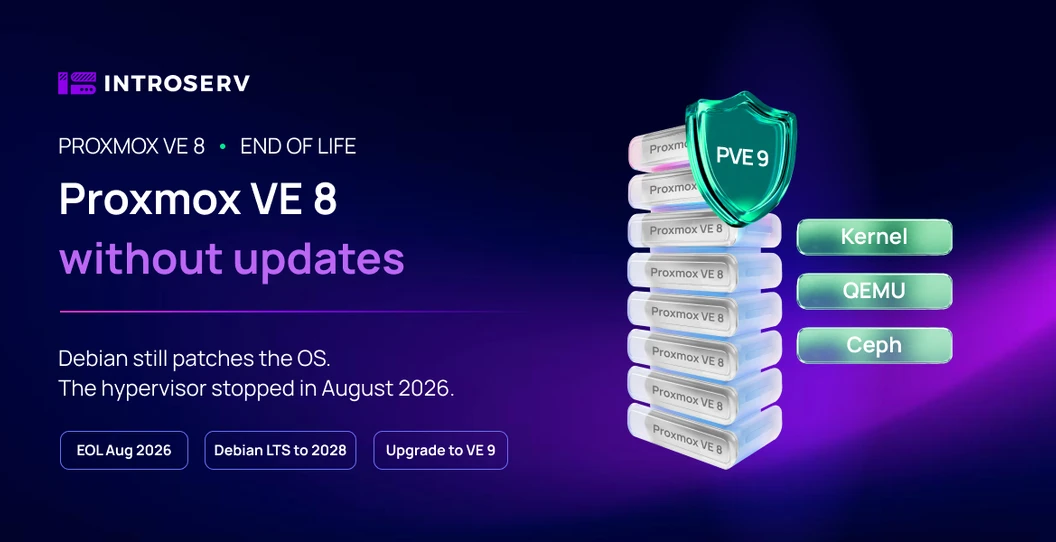

Proxmox VE 8 without updates: what it means for your server

Proxmox VE 8 without updates: what it means for your server

Paying for Hosting with Cryptocurrency: When It Is More Convenient Than a Card or Bank Transfer
Cryptocurrency is a convenient additional payment method for hosting, especially when a card is declined, a bank transfer takes several days, or the budget is already held in digital assets. At INTROSERV, payments through CoinsPaid and CoinGate are credited to the account balance in EUR and can be used for VPS/VDS, dedicated servers, IP addresses, licenses, and renewals. The main advantages are greater flexibility, fewer intermediary steps, and a backup payment option for international customers.

Latency 101: Why Physical Data Center Location Still Matters More Than People Assume
This article explores why data center location remains a critical factor in hosting performance, even when powerful hardware is available. It explains how physical distance creates unavoidable network latency, why faster CPUs and more RAM cannot eliminate transmission delays, and how round-trip time affects the speed users actually experience. The article also highlights why server location should be considered alongside hardware specifications when choosing infrastructure for applications, websites, and other latency-sensitive services.

NVMe vs. SATA SSD vs. HDD: When a Storage Upgrade Actually Pays Off
Business storage upgrades should be evaluated based on return on investment (ROI), not benchmark results, with hardware selected for specific workloads. While NVMe is suitable for latency-sensitive processes, SATA SSDs and HDDs remain cost-effective solutions for general workloads and long-term archiving. More information is available on the INTROSERV website.

Tier III Data Center: What It Means, Requirements, Uptime, and Benefits
Tier III data centers provide an optimal balance of availability, redundancy, maintainability, and cost for business-critical infrastructure. Their defining feature is concurrent maintainability, which allows key power, cooling, and distribution components to be serviced while IT workloads remain online.

Best Practices to Enhance cPanel Hosting Security in 2026
This article provides a practical overview of the key steps needed to improve cPanel hosting security in 2026. It covers secure access, strong authentication, regular updates, backups, malware protection, account permissions, and server-level security measures, while distinguishing between actions available to standard cPanel users and those that require WHM or root access.


